It's time to unlock the secrets of H-tags and elevate your content structure for better online visibility. By effectively utilizing heading tags, you can guide readers through your text while improving SEO performance. This blog will help you grasp the importance of these tags and show you how to implement them effectively. For further insights, check out this resource on Mastering Heading Tags: Meaning, Examples, & Pro Tips. Let’s examine the world of H-tags and transform your content strategy!

Key Takeaways:
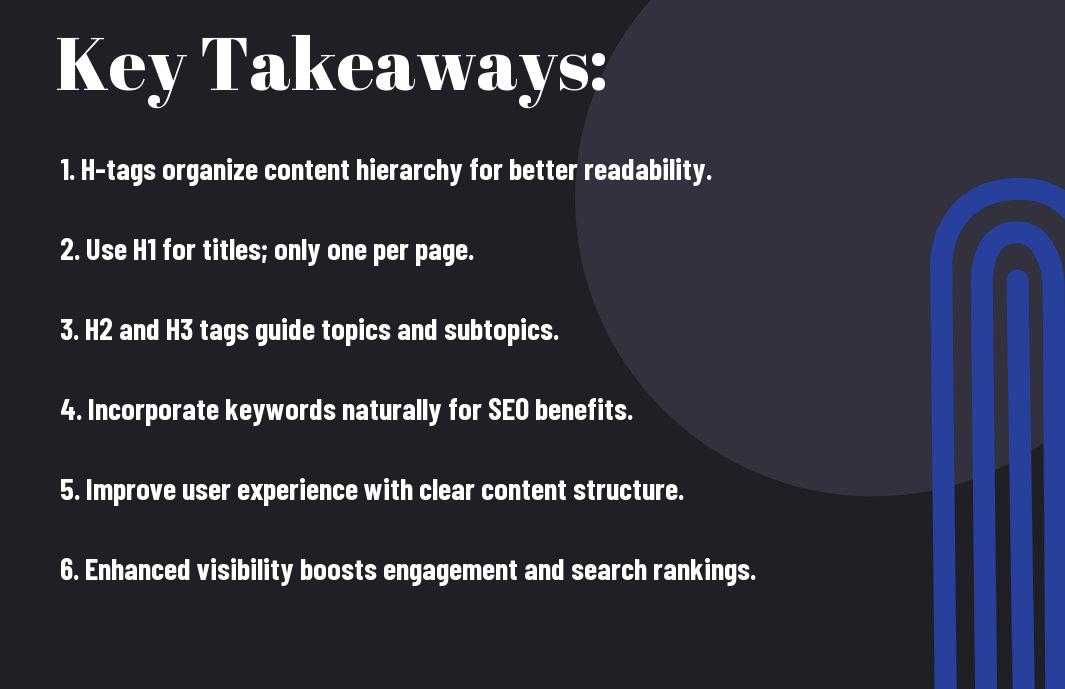
- Understanding H-Tags: H-tags, or header tags, play a vital role in organizing content and guiding search engines through the hierarchy of information on a webpage.
- SEO Benefits: Properly utilizing H-tags can significantly enhance your site's SEO, making it easier for search engines to index your content and improving your visibility in search results.
- User Experience: Well-structured content with clear H-tag usage not only helps with SEO but also provides a better user experience by making it easier for readers to navigate and find information.
Understanding H-Tags
For anyone looking to improve their content's structure and search engine visibility, understanding H-tags is vital. H-tags, or header tags, are HTML elements used to define headings and subheadings in your content. They not only help readers navigate your articles but also allow search engines to grasp your content's hierarchy, which can boost your SEO performance.
Definition and Purpose
With header tags, you can create a clear structure for your content, making it easier for both users and search engines to understand the main points. The primary purpose of H-tags is to organize information hierarchically within your page, enhancing the readability and SEO of your content.
Types of H-Tags
There are six levels of H-tags, ranging from H1 to H6, each with a specific role in structuring your content:
| H1 | Main title of your page |
| H2 | Key sections or main topics |
| H3 | Subsections or details under H2 |
| H4 | Further divisions under H3 |
| H5 & H6 | Additional sub-levels for complex content |
Knowing how to use each tag properly allows you to optimize your content effectively.
A deeper understanding of these types can greatly enhance your content's clarity and focus. Each H-tag serves a purpose, allowing readers to easily scan your document. Here’s a quick overview of how you can leverage each tag:
| H1 | Use once per page to define the topic |
| H2 | Utilize multiple times for main sections |
| H3 | Break down sections into detailed parts |
| H4 | Provide clarity in complex topics |
| H5 & H6 | Niche divisions for very detailed content |
Knowing how to implement these tags effectively can significantly improve the user experience and visibility of your content online.
The Importance of H-Tags in SEO
Assuming you're looking to enhance your website’s visibility, understanding the role of H-tags is vital. These HTML elements help search engines comprehend the structure and hierarchy of your content, allowing your pages to rank more effectively. By properly utilizing H-tags, you not only improve SEO but also make your content easier for readers to navigate, resulting in a more engaging user experience.
Impact on Search Engine Ranking
About H-tags, they serve as vital signals to search engines regarding the importance of various sections within your content. Search engines prioritize websites that use logical H-tag hierarchy, meaning well-structured content has a greater chance of ranking higher. By strategically placing relevant keywords in your H-tags, you can further enhance your chances of attracting more organic traffic.
H-Tags and User Experience
Below the surface, H-tags play a significant role in shaping user experience on your website. They guide readers through your content, making it easier to digest and allowing you to present information in a clear hierarchy.
Indeed, using H-tags effectively can lead to a more organized and visually appealing layout, which keeps your audience engaged. When users can quickly skim through your content and identify key sections, they are more likely to stay on your page longer. An improved user experience often translates into lower bounce rates and higher conversion rates, thereby enhancing the overall effectiveness of your online presence.
Best Practices for Using H-Tags
Not using H-tags effectively can lead to a disorganized content structure, which can negatively impact your online visibility. To enhance your content's readability and search engine performance, you should follow best practices for employing H-tags. Prioritize a clear hierarchy, proper usage, and strategic keyword integration to make your content more accessible and engaging for your audience.
Proper Hierarchy and Structure
Between the various H-tags, you should establish a natural flow between headings and subheadings. Utilize H1 for your main title, and H2 for primary sections, followed by H3 for subsections. This not only aids in content organization but also helps search engines understand your content better, improving your visibility.
Keyword Optimization Strategies
HTags play a significant role in optimizing your content for search engines. By integrating relevant keywords into your headings, you can enhance your content’s visibility and attract the right audience.
Strategies for keyword optimization include using primary keywords in your H1 and secondary keywords in H2 and H3 tags. This way, you signal to search engines what your content is about while ensuring that your headings provide context for your readers. Avoid overstuffing keywords, and maintain clarity and relevance in your headings to encourage better engagement and higher rankings.
Common Mistakes to Avoid
Keep your focus on the purpose of H-tags: to structure your content effectively. Overlooking this can lead to disorganized pages that confuse both readers and search engines. Aim for a balanced hierarchy that enhances readability and maintains relevance. Don’t forget to periodically assess your use of H-tags to ensure they are serving their intended function.
Overusing H-Tags
Behind every effective page is a well-thought-out structure, and overusing H-tags disrupts that balance. Too many H-tags can create visual clutter and confuse both your audience and search engine crawlers. Aim for clarity by using H-tags sparingly and appropriately, ensuring each level complements your content’s flow and hierarchy.
Ignoring Semantic HTML
HTags serve a purpose beyond just visual appeal; they play a role in conveying meaning to search engines. If you ignore semantic HTML, you risk limiting your content’s discoverability. Each tag carries a context that search engines utilize to understand your content better. Use H-tags in a way that reflects your content's importance; this enhances SEO and user experience.
Due to this oversight, you may jeopardize your online visibility and diminish the effectiveness of your content. Semantic HTML not only aids in readability but also in providing context. Every time you apply an H-tag, consider its role in the overall structure and meaning of your content. By adopting a semantic approach, your material becomes more accessible to both users and search engines, ultimately enhancing engagement.
Tools and Resources for H-Tag Implementation
Unlike the common misconception that H-tags are solely about formatting, they are integral to your content's visibility and usability. Utilizing the right tools can streamline the implementation process, ensuring that your headings are not only optimized but also structured for reader engagement. By leveraging various resources, you can enhance your understanding and application of H-tags to elevate your online presence.
SEO Audit Tools
Tools like SEMrush and Ahrefs provide comprehensive SEO audits, highlighting the structure of your headings and the overall health of your content. By regularly analyzing your website with these tools, you can pinpoint issues with H-tag usage and identify areas for improvement. This ensures that your headings effectively guide both search engines and readers through your content, ultimately boosting your search engine ranking.
Content Management Systems
An effective Content Management System (CMS) simplifies the application of H-tags across your site. With user-friendly interfaces, platforms like WordPress, Wix, and Squarespace allow you to easily format headings as you create or edit content. The built-in features generally provide recommendations on tag hierarchy, helping you maintain consistency and clarity throughout your pages.
In fact, many popular CMS platforms come equipped with plugins or extensions designed to optimize your H-tag usage further. These tools not only help automatically format your headings but also can provide suggestions tailored to SEO best practices. By seamlessly integrating H-tag management into your content creation workflow, you enhance both the readability and searchability of your articles.
Case Studies: Successful H-Tag Implementation
Once again, let’s take a closer look at some impressive case studies that showcase how effectively implemented H-tags can significantly enhance your content structure and visibility:
- Company A: Enhanced organic traffic by 72% after restructuring H-tags on key service pages.
- Blog B: Achieved a 50% increase in page views and a 30% drop in bounce rate within three months of H-tag optimization.
- Website C: Improved keyword rankings for 10 major search terms, moving from the second page to the first page of Google results.
- Agency D: Noticed a 25% increase in user engagement after implementing consistent H-tag strategies across all blogs.
Examples of Improved Rankings
An analysis of the aforementioned case studies reveals a clear pattern: structured H-tags contribute to improved rankings. For instance, Company A's optimization led to a significant leap in visibility for critical keywords, positioning them within the first few results of search engines.
User Engagement Metrics
Implementation of structured H-tags has a direct correlation with user engagement metrics. Enhanced readability stemming from organized content is pivotal in capturing your audience’s attention and retaining their interest.
Examples from the case studies indicate that a well-organized framework, complemented by effective H-tags, often results in substantial improvements in user metrics. You may observe increased time on page, higher click-through rates, and a reduction in bounce rates, reflecting that users not only find your content more accessible but are also more inclined to engage with it meaningfully.
To wrap up
Drawing together the insights from this guide, understanding H-tags can significantly enhance your content structure, helping your audience navigate your material more effectively. By strategically utilizing these tags, you improve your online visibility, as search engines appreciate well-organized content. As you implement these practices, you’ll find that both user experience and search performance benefit, ultimately leading to more engaged readers and better results for your efforts.
FAQ
Q: What are H-tags and why are they important for web content?
A: H-tags, or header tags, are HTML elements that define the headings and subheadings within your web content. They range from H1, which is usually the main title of the page, to H6, which is the least important heading. H-tags play a significant role in organizing content for both readers and search engines, enhancing the readability and structure of the information presented. Proper use of H-tags helps improve online visibility by making it easier for search engines to understand the hierarchy and context of the content, ultimately leading to better search rankings.
Q: How should I structure H-tags in my article for optimal SEO?
A: To structure H-tags effectively for SEO, start by using a single H1 tag for the main title of your page, which should clearly convey the primary focus of the content. Follow this with H2 tags to introduce main sections of your article, providing a clear outline of topics. Within each H2 section, use H3 tags to elaborate on subtopics, and H4 tags if you need further distinctions. This hierarchical organization not only aids readers in navigating the content but also signals to search engines the importance of different sections, thereby enhancing the chances of improved visibility.
Q: Can using H-tags incorrectly harm my content's performance online?
A: Yes, improper use of H-tags can negatively impact your content's performance. Using multiple H1 tags on a single page can confuse both readers and search engines regarding the main topic. Additionally, skipping heading levels or using H-tags merely for stylistic purposes, rather than structural clarity, can lead to misunderstandings about the content’s hierarchy. This misalignment can hinder the user experience and make it harder for search engines to index the material correctly, which may result in lower search rankings and reduced online visibility.


 Posts
Posts


0 Comments