Anchor text plays a significant role in your SEO strategy, influencing both user experience and search engine rankings. By selecting descriptive, relevant text for hyperlinks, you can provide context for your audience and search engines alike. To enhance your understanding and implementation, explore Best Practices for Optimizing Anchor Text. This knowledge will empower you to create a robust link-building strategy that enhances your site's visibility and authority.
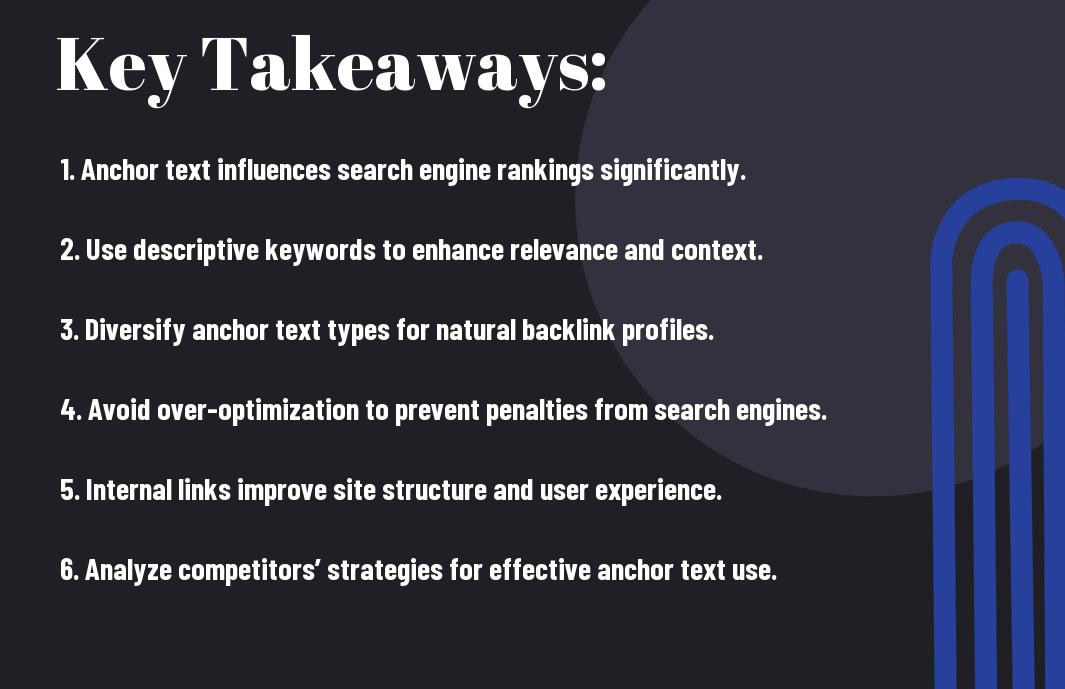
Key Takeaways:
- Anchor Text Relevance: Using descriptive and relevant anchor text helps search engines understand the context and content of the linked page, enhancing SEO performance.
- Variety in Anchor Text: Employing a diverse range of anchor text types (exact match, partial match, branded, etc.) can improve link-building strategies and reduce the risk of penalties.
- User Experience: Well-structured anchor text enhances user experience by providing clear navigation cues, leading to higher engagement and lower bounce rates on your website.
What is Anchor Text?
For effective SEO, understanding Anchor Text is vital. It refers to the clickable text in a hyperlink that directs users to another webpage or resource. The words you choose for anchor text can significantly impact both user experience and search engine optimization strategies.
Definition and Importance
Anchor text is the visible, clickable text in a hyperlink that provides context to both users and search engines. The right anchor text not only enhances navigability but also boosts your SEO efforts by signaling relevance and authority to search engines, improving your site’s ranking.
Types of Anchor Text
Any effective SEO strategy should include various types of anchor text to enhance your link-building efforts. Here are the main categories:
| Type | Description |
|---|---|
| Exact Match | Uses a keyword as the anchor text. |
| Partial Match | Contains a variation of the keyword. |
| Branded | Includes a brand name as anchor text. |
| Naked Link | Displays the raw URL as the clickable text. |
| Generic | Uses non-descriptive text like 'click here'. |
- Thou should consider these types to create an optimized linking strategy.
Types of anchor text can dramatically influence your SEO performance. By selecting the appropriate type, you guide users and search engines toward understanding the context of linked content. This ensures better visibility and relevance. Incorporating a variety of anchor text types in your strategy helps to diversify your link profile and enhances your site's authority.
| Anchor Text Type | Benefits |
|---|---|
| Exact Match | Improves ranking for specific keywords. |
| Partial Match | Supports broader keyword relevance. |
| Branded | Builds brand recognition. |
| Naked Link | Makes it clear where the link leads. |
| Generic | Easy to use in various contexts. |
- Thou should balance anchor text types for a holistic SEO approach.
The Role of Anchor Text in SEO
Even a small change in your anchor text can significantly influence how your audience and search engines perceive your content. Anchor text serves as a bridge between your website and other relevant pages, guiding users and search engines alike. When used effectively, it enhances user experience by providing context, improving navigation, and boosting your content's relevance, ultimately contributing to a stronger SEO strategy.
How Search Engines Use Anchor Text
Any time you include anchor text in your content, search engines analyze it to determine the nature and context of the linked page. By evaluating the words used in your anchor text, search engines can ascertain the subject matter of both the linking and linked pages. This helps them categorize and rank your content appropriately, influencing how competitive your pages are in search results.
Impact on Rankings and Visibility
Search engines place significant value on the anchor text associated with links to your site. The specific keywords you choose can help signal relevance to search queries, thereby affecting your visibility in search results. Optimizing anchor text not only improves user experience, it can directly lead to higher rankings for your content.
For instance, if you use descriptive and keyword-rich anchor text that accurately reflects the linked content, search engines may prioritize your page for those keywords. This means that users searching for related information are more likely to encounter your site. In return, leveraging optimal anchor text can lead to increased organic traffic, enhancing your overall visibility in a crowded digital marketplace.
Best Practices for Using Anchor Text
Once again, applying best practices to anchor text can enhance your SEO efforts significantly. You should aim to create a diverse anchor text profile that includes exact match, broad match, branded, and generic anchor texts. This variety ensures a natural link building approach, helping search engines better understand the context of your content. Additionally, avoid over-optimizing by limiting the use of exact match keywords—focus on providing value to your readers through meaningful hyperlinks.
Keyword Optimization
Below, you’ll find that keyword optimization plays a vital role in anchor text effectiveness. Choosing relevant keywords in your anchor text can improve visibility on search engines, guiding users and search engines alike to your content. Strive to integrate keywords naturally within the text, ensuring they fit seamlessly into the overall narrative while still highlighting the targeted page.
Relevance and Context
Best practices dictate that you link to content that is relevant and provides context to your anchor text. This not only improves user experience but also helps search engines understand the relationship between linked content, improving overall rankings.
A well-placed, contextually relevant anchor text signals to readers what to expect from the linked page. This relevance fosters trust, as visitors are more likely to engage with your content when it aligns with their interests. Always evaluate whether your anchor text enhances the informative nature of your content while guiding users effectively to what they seek.
Common Mistakes to Avoid
Now that you understand the importance of anchor text, it's vital to recognize common mistakes that can undermine your SEO efforts. Many website owners overlook the nuances of anchor text, which can lead to ineffective linking strategies and potentially lower search engine rankings. Avoiding these pitfalls will enhance your SEO performance and contribute to a more effective strategy.
Over-optimization
By using overly optimized anchor text, you run the risk of appearing manipulative to search engines. When your anchor text is excessively keyword-focused, it can raise red flags for algorithms, potentially resulting in penalties. Instead, aim for natural-sounding phrases that flow within your content.
Ignoring Brand and Context
Beside focusing solely on keywords, you should not overlook the importance of brand and contextual relevance in your anchor text strategy. Incorporating your brand name and considering the surrounding content provides a more balanced approach to your linking strategy.
Considering the role that brand recognition plays in an effective anchor text strategy is vital. When your anchor text includes your brand name, it not only builds awareness but also enhances credibility with users and search engines alike. Additionally, using contextual keywords helps search engines better understand the content of your linked pages, improving your chances of ranking higher in search results. Strive for a blend of brand prominence and relevant context to foster stronger SEO outcomes.
Monitoring and Analyzing Anchor Text
Unlike static elements of SEO, anchor text requires ongoing monitoring and analysis to remain effective. By keeping track of how your anchor text performs in various contexts, you can determine which links drive the most traffic and enhance your site’s authority. Regular assessments help you identify opportunities for optimization, ensuring your SEO strategies remain relevant and impactful.
Tools for Analysis
Anchor text analysis can be streamlined with a variety of tools. Platforms such as Google Search Console, Ahrefs, and Moz offer insights into the performance and distribution of your anchor texts. These tools allow you to evaluate metrics like click-through rates and the diversity of anchor text used, helping to fine-tune your linking strategy for better visibility and user engagement.
How to Adjust Strategies
Strategies may need adjustments based on the data gathered from your anchor text analysis. This involves refining your approach by diversifying your anchor texts, ensuring a balanced mix of branded, generic, and exact match terms. Analyzing competitor anchor text can also provide valuable insights that inform your own strategy. You should be proactive in adapting to changes in search engine algorithms and user behavior to maintain optimal performance.
Indeed, fine-tuning your strategies based on analysis is vital to maintaining effectiveness. By regularly revisiting your anchor text distribution and engaging in A/B testing with different variations, you can ascertain what resonates with your audience. As you gather more data over time, you’ll be better equipped to make informed decisions that enhance your link-building efforts and improve your site's SEO performance.
Future Trends in Anchor Text and SEO
All digital marketers must keep an eye on future trends regarding anchor text and SEO, as these elements continue to evolve alongside search engine algorithms. As Google and other search engines refine their methods for content evaluation, understanding how to leverage anchor text effectively will be key to boosting your website's visibility and authority. Staying informed about these shifts can empower you to adapt your strategies accordingly, ensuring your SEO remains effective in an ever-changing landscape.
Evolving Algorithms
Beside focusing on traditional keyword density, search engines will increasingly prioritize content relevance over the sheer number of keywords present in anchor text. This means you must create high-quality, engaging content and use anchor text that reflects the context rather than just targeting specific keywords. By doing so, you'll align better with search engine expectations and enhance your chances of ranking higher.
User Experience Considerations
On the other hand, crafting an intuitive user experience will play a vital role in your SEO strategy moving forward. Search engines are moving towards metrics that reflect user interaction and satisfaction, so focusing on clarity and relevance in your anchor text will enhance both user experience and your SEO performance.
Also, think about how your choices in anchor text can affect navigation and engagement on your site. When you use descriptive, meaningful anchor text, you guide users through your content smoothly, improving their experience. This, in turn, can decrease bounce rates and increase the time visitors spend on your site, leading to better SEO outcomes. By prioritizing user experience alongside effective anchor text, you create a holistic approach that benefits both your audience and your search engine rankings.
Conclusion
Considering all points, understanding anchor text is necessary for enhancing your SEO strategies. By effectively utilizing descriptive and relevant anchor text, you can improve your site's visibility and drive targeted traffic. This knowledge not only allows you to make informed decisions about your link-building efforts but also enhances user experience and engagement. As you implement these insights, you'll notice significant improvements in your search engine rankings and overall online presence.
FAQ
Q: What is anchor text and why is it important for SEO?
A: Anchor text refers to the clickable text in a hyperlink that users see on a webpage. It typically appears as underlined text and is often different in color from the surrounding text. Anchor text is important for SEO because it provides context to both users and search engines about the content of the linked page. A well-optimized anchor text can enhance the relevance of the linked content, improve user experience, and contribute positively to a website's search engine ranking.
Q: How can I effectively utilize anchor text in my SEO strategy?
A: To effectively utilize anchor text in your SEO strategy, consider the following practices: Use descriptive and relevant keywords within the anchor text instead of generic phrases like 'click here.' Keep variations with different yet related keywords to avoid over-optimization. Additionally, ensure that the anchor text accurately reflects the content of the linked page, which helps maintain user trust and decreases the bounce rate. Lastly, Build a natural link profile by mixing different types of anchor text, such as branded, generic, and exact match links, to improve your overall SEO health.
Q: What are the potential pitfalls to avoid while using anchor text?
A: There are several pitfalls to avoid when using anchor text. One major issue is keyword stuffing, where the same keyword is overused in anchor text. This can lead to penalties from search engines. Another common mistake is using overly generic anchor text, like 'read more' or 'link here,' which doesn’t provide any context about the linked content. Additionally, ensure that the anchor text links to relevant and high-quality content; linking to low-quality pages can harm your site's credibility. Lastly, being mindful of the balance between internal and external links can help maintain a healthy link profile.


 Posts
Posts


0 Comments